

 POS, aka point of sale, information has historically been a challenge, and a topic, within the industry.
Many distributors refrain from sharing much information with their manufacturers out of concern about what they will do with the information, who has access to it, will some information make its way to support another distributor, will they sell direct, and more.
Reps desire distributors to share this information, especially if they have CDCs or RDCs so that they can get compensated appropriately for sales within their territory. In this application, POS really becomes “place of sale” meaning branch or geographic (hence their desire for zip code level information) and they are okay without having customer names (after all, they should know the customers in the territory.) This is the reason why NEMRA, in conjunction with manufacturers, developed the Minimum POS Reporting Standards that has been endorsed by NAED along with over 50 distributor and manufacturer entities. (Note: Channel Marketing Group facilitated this initiative for NEMRA and continues to support this initiative. If you have questions, would like more information, or would like to endorse, feel free to contact me.)
Most manufacturers want the information to compensate their reps / salespeople / regional management appropriately while others want the information for business intelligence / sales analytics purposes.
But there are still distributors who do not share the appropriate information with manufacturers AND there are manufacturers who do not gather the information and share it appropriately with their reps. The result is that reps (and perhaps more specifically, some of their salespeople) are not compensated appropriately and, when they are not, they may not support a distributor as “fully” as they could.
Further, manufacturers and distributors do not benefit from the potential that sales analytics can deliver. Manufacturers can analyze aggregated information to share localized insights with their distributors such as top selling SKUs in the marketplace, a correlation between specific product categories and applications within vertical markets and more.
In some industries, POS data collection and sharing is a way of life and an expectation. In fact, in the electronic industry, distributors and manufacturers utilize it as part of their planning process as it frequently captures information at the NAICS level, generating further insights.
POS is an area where the electrical industry is behind but which, individually, companies can differentiate themselves.
Larry White from Interlynx Systems has been supporting manufacturers with POS collection infrastructure for many years. He even has clients in the electrical industry and a number in the automation space (which technically is part of the electrical industry.) He shares some insights on how POS can help manufacturers and distributors act on the information, which is more important than ever in a challenging market (when you exclude data center business.)
POS Data Can Drive Sales Performance and Accountability
Using distributor sales data to improve territory performance and manufacturer–rep accountability.
Electrical manufacturers have a challenge when it comes to distributor point-of-sale (POS) data. Most distributors don’t provide complete end-customer information, often because of contractual restrictions.
If you’re getting full POS data with customer names, great. You know who’s buying your products, where business is growing, and where opportunities exist.
But most manufacturers aren’t that fortunate.
That doesn’t mean the information you’re getting isn’t valuable. In fact, even without customer names, POS data can be one of the best tools for managing territory performance and working more effectively with your independent reps.
Start With the Numbers
You have sales by distributor, territory, rep, SKU, and product family. You know which products are growing, which are declining, and how new products are performing.
That’s great information for sales reporting and calculating rep commissions.
But I think there’s a bigger opportunity here.
Use that information to sit down with your reps and develop a plan.
How’s the territory doing? Which product families are underperforming? Are new products gaining traction? Are certain SKUs losing momentum?
You may not know every customer behind those numbers, but you have a pretty good understanding of what’s happening.
And your rep can help fill in the story.
Identify the Threats and Opportunities
There’s a lot more you can learn from POS data than simply whether sales are up or down.
For example:
- Declining sales: Which SKUs and product families are losing momentum?
- Lost sales: Which products had previous sales activity but have stopped selling?
- New sales: Which SKUs are generating sales for the first time?
- Growing sales: Which products are gaining momentum?
- New product performance: How are recently introduced products performing across territories?
- Territory performance: Which reps and regions are outperforming or underperforming?
- Distributor performance: Which distributors are growing, declining, or changing their product mix? Perhaps at the branch level as you geo-tag branches by zip code.
Now you have something meaningful to discuss with your reps.
Why is one product family declining while another is growing? Why are new products doing well in one territory but not another? What can we learn from the territories that are performing well?
These are the kinds of questions that should drive your sales planning. This information helps regional managers become more strategic.
Turn POS Information into a Plan
The next step is agreeing on what you’re going to do.
Maybe a declining product family needs more distributor attention. Maybe a new product needs additional training or promotion. Or perhaps a rep needs help understanding why certain SKUs have stopped selling.
The manufacturer and rep should agree on priorities, responsibilities, and objectives.
And accountability works both ways. If the manufacturer wants better new product sales, perhaps the rep needs training, samples, or additional support.
At the next review, you look at the POS information again and measure whether you’re making progress.
That’s how you turn reporting into something useful.
Fill In the Customer Information
Of course, these plans become more effective when you can identify the customers behind the sales.
One place to look is special pricing contracts. Many electrical distributors conduct a significant portion of their business through these agreements. In some cases, 50% or more of their transactions may be tied to special pricing.
Those contracts often identify the end customer, even when regular POS reporting doesn’t.
Drop shipments are another source. When you’re shipping directly to a customer on behalf of a distributor, you may have the ship-to information.
And don’t overlook your reps. They know their territories, the distributors, and many of the customers purchasing your products.
Bring those sources together, validate the information, and you can start connecting customer activity to territory performance.
The more customer information you have, the more specific your sales plans can become.
The Bottom Line
You don’t need complete customer-level POS data to manage your territories effectively.
Start with the information you have. Identify threats and opportunities. Review performance with your reps, agree on priorities, and measure the results.
Then keep filling in the customer information wherever you can.
The real value of POS data isn’t just knowing what happened. It’s having a plan for what you’re going to do next.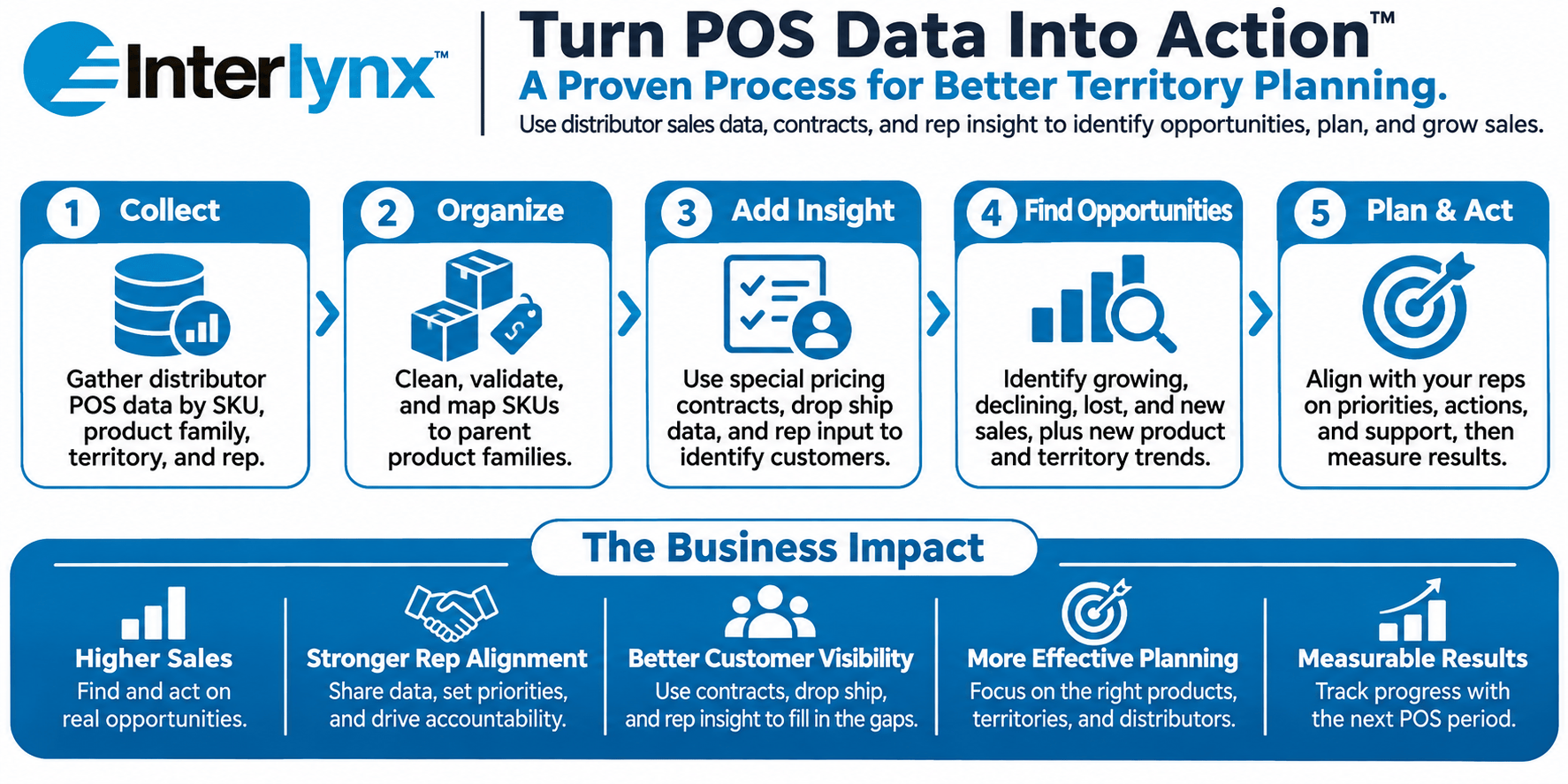
About the Author
Larry White is President of Interlynx Systems, a provider of Channel Performance Systems for manufacturers, independent representatives, and distributors, with a strong focus on the electrical and electronics industries.
Making POS Actionable
- If you are not handling POS information appropriately internally, consider outsourcing the initiative. The data collection process can occupy much time due to changes and your technology team is focused on other things (especially if you have an AI mandate.) Finance needs a auditable file to pay reps. It doesn’t hurt to task someone into reviewing your current process and talking to Interlynx to understand their offering.
- If you have not endorsed the NEMRA Minimum Reporting Standards, should you?
- If you are a distributor, have you advised your reps that you do share POS information with your / their manufacturers? There are some manufacturers who do not share the sales detail with them so that the rep cannot apportion it appropriately to their salespeople who call on your branches (and the rep does not want your customer information, only zip code information.) If you do provide POS information to your manufacturer(s), perhaps ask them how they are using it? Are they sharing it appropriately with your reps? Or do you need to offer this service and hence capture greater support from your reps?
- Manufacturers, have you trained your regional managers on how to use this information to make planning more effective? To increase their value to their distributors? Their reps?
- And remember, this can also impact their compensation so it should be of interest to them.
In an age of accountability and data, shouldn’t POS reporting be important to understanding performance, ensuring appropriate compensation, and utilizing the information to drive future sales?

Trending Now


Turn POS Data into Action
You may also like