

 Recently I saw two news stories that got me wondering. The first was New York State’s moratorium on data center construction. The second was a county here in North Carolina that also implemented a moratorium, and the newscast went on to state that fourteen (14) NC counties have also implemented a moratorium.
While government entities and the “public” debate the implications of data centers (utility usage / costs, water usage, best usage of land, jobs, tax credits, etc) it got me also thinking about the ripple effects of data centers in the sense of other construction surrounding new data centers (due to employment and/or the construction of the data center.)
This coincided with receipt of John Gross’ Copper Update where he also had information on construction spending – residential, commercial, and industrial.
I send Chris Sokoll from DISC a note sharing John’s information and suggested a chart that overlayed construction information with resi, commercial, industrial and data center construction as my sense was without data centers, and the commercial construction, maybe even resi in some markets, nationally we’d be in a construction recession which, going back to the state / county moratoriums, should make distributors, reps, and manufacturers question their sales goals in these markets for the next year … maybe multiple years. What will drive growth in those markets?
This got Chris into thinking, digging (researching) and he shared his observations.
Data Centers Have Become the Office Market: What Census Data Reveals About a Hidden Construction Recession
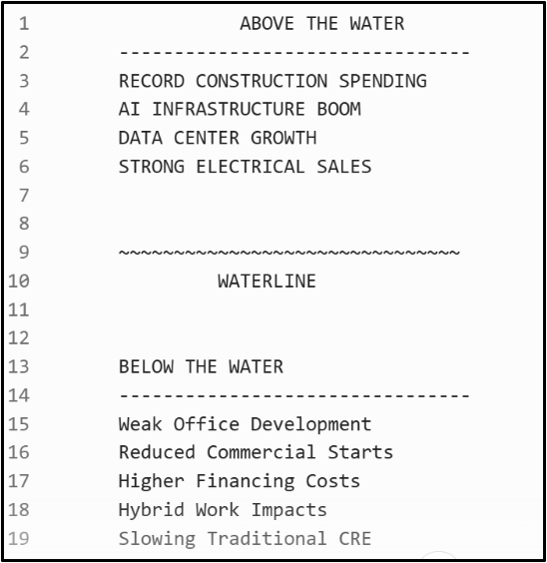 For years, economists, contractors, and commercial real estate professionals tracked “office construction” as a proxy for business expansion. Today, that measure tells a very different story. According to a new U.S. Census Bureau category, data centers have officially become the largest component of private office construction in America, fundamentally reshaping how we interpret construction activity across major metropolitan areas.
The implications are significant. While headline office construction spending appears relatively healthy, much of the growth is no longer tied to traditional buildings occupied by workers. Instead, it is driven by hyperscale data centers built to support cloud computing, artificial intelligence, and digital infrastructure. In several major metro areas, removing data center investment from the equation could reveal construction environments that are much closer to recessionary conditions than aggregate numbers suggest.
A Historic Shift in the Office Category
The Census Bureau recently began reporting data center construction as a distinct component of private office construction, offering visibility into a market that had previously been buried within broader office statistics. The results are striking. In April 2026, data center construction spending reached a seasonally adjusted annual rate (SAAR) of $50.7 billion, surpassing traditional office construction spending of $43.8 billion. Data centers represented approximately 52% of all private office construction activity in the U.S.
Just five years ago, office construction was primarily associated with corporate headquarters, suburban office campuses, medical office buildings, and downtown towers. Today, the majority of activity within the sector is tied to facilities housing servers rather than employees. This transformation reflects the explosive growth of AI-related infrastructure spending and the continued challenges facing conventional office markets due to hybrid work patterns, elevated financing costs, and changing workplace strategies.
The trend has accelerated rapidly. Census-based estimates indicate data center construction spending has increased more than fivefold since 2020, while traditional office construction has steadily declined from its pre-pandemic-era peak.
Why the Distinction Matters
At first glance, the construction data appears positive. Total office-related spending remains substantial, supporting employment for contractors, engineers, and specialty trades. However, the composition of that spending is increasingly concentrated within a narrow set of projects and geographies.
Data centers differ dramatically from traditional office developments. They require large amounts of electrical infrastructure, cooling systems, and specialized construction expertise. They also tend to be financed by hyperscalers and technology firms with enormous capital budgets, making them less sensitive to interest rate pressures than most commercial real estate sectors.
As a result, headline construction numbers may overstate the health of broader commercial development. A market dominated by data centers can show robust construction spending even while traditional office, retail, multifamily, and mixed-use development are slowing materially.
The Metro Areas Most Dependent on Data Centers
The concentration of data center development is remarkably narrow. A handful of metropolitan areas account for a disproportionate share of national activity, creating localized construction booms. The most prominent include:
- Northern Virginia (Washington, D.C., MSA)
- Dallas-Fort Worth
- Phoenix
- Atlanta
- Columbus, Ohio
- Richmond and emerging Virginia markets surrounding Northern Virginia
Northern Virginia remains the most significant market globally, with millions of square feet under development and some of the lowest vacancy rates in the industry. Atlanta and Phoenix have rapidly expanded their pipelines, while Dallas-Fort Worth has emerged as one of the industry’s largest growth markets due to available land and power infrastructure. However, Texas Gov. Greg Abbott recently called for blocking new data center development, so DFW construction rates may be jeopardized. According to the Texas Tribune, although Abbott’s ban specifically refers to rural areas, he also unveiled a “sweeping regulatory framework” calling for data centers to add new power generation to the Texas independent grid, pay infrastructure costs, reuse water, and implement setbacks, all aimed at limiting their impact on residential communities.
CBRE data shows that Northern Virginia, Dallas, Phoenix, and Atlanta continue to absorb enormous amounts of capacity, largely driven by hyperscale cloud providers and AI infrastructure deployment.
Could Some MSAs Be in a Construction Recession Without Data Centers?
This is perhaps the most important question for contractors, distributors, reps, manufacturers, lenders, and economic development professionals.
In several leading data center markets, construction activity is increasingly concentrated in projects that do not reflect the health of the broader commercial real estate. If data center construction were removed from local spending totals, many MSAs would likely exhibit characteristics associated with a construction recession, including declining office starts, reduced commercial development pipelines, and weaker private-sector investment.
Northern Virginia
Northern Virginia offers the clearest example. Traditional office demand remains constrained as employers continue optimizing real estate footprints and embracing hybrid work arrangements. Yet overall construction activity remains robust because of massive data center campuses spreading into Loudoun, Prince William, Culpeper, Spotsylvania, and surrounding counties. Without this infrastructure buildout, commercial construction metrics would be significantly weaker.
Dallas-Fort Worth
Dallas continues to benefit from population growth and diversified development, but data center investment has become an increasingly important component of its construction pipeline. CBRE identifies the market as one of North America’s leading data center destinations, generating substantial absorption and development activity. Excluding data center spending would materially reduce commercial construction growth rates.
Phoenix
Phoenix has experienced extraordinary data center growth due to favorable land availability, climate advantages, and access to power infrastructure. At the same time, broader commercial development has faced pressure from higher financing costs and slowing economic momentum. Data center activity is helping offset softness elsewhere.
Columbus and Atlanta
Both markets have become major beneficiaries of hyperscale expansion. The influx of technology infrastructure projects has created significant demand for contractors and construction labor. However, these metros are increasingly reliant on digital infrastructure investment to maintain elevated construction volumes.
The Bottom Line
The Census Bureau’s decision to separate data centers from traditional office construction has revealed one of the most important structural shifts in U.S. construction today. Data centers are no longer a niche segment hidden within office statistics. They are now the largest component of private office construction, accounting for roughly half of all spending in the category.
For investors, contractors, distributors, reps, manufacturers and economic analysts, this changes how construction activity should be evaluated. Strong headline office construction numbers may no longer indicate healthy demand for conventional commercial space. Instead, they may primarily reflect the unprecedented capital expenditures tied to AI, cloud computing, and digital infrastructure.
Looking ahead, the key question is not whether construction remains strong, but whether growth is broad-based or increasingly dependent on a single asset class. In several leading MSAs, removing data center construction from the conversation could expose an uncomfortable reality: portions of the commercial construction market are already operating in recessionary territory.
Things to Think About
- For larger distributors, this may be a non-issue as they are winning business throughout the country.
- For smaller distributors who cannot / do not compete for data center business due to their size, borrowing ability / resources, business focus, sales contacts, access to lines, etc. … it highlights why there is a tale of two markets. Larger companies report stronger sales as they are beneficiaries of servicing data centers / elements of a data center. Smaller companies frequently do not have this opportunity.
- If you are a rep in New York, when a manufacturer talks data centers in 2027, perhaps 2028, … it will fall on deaf ears. Goals, and expectations need to be reset. Same in other areas.
- This begs the need for more nuanced business planning going forward. If you’re using DISC’s Market Track or Data Search databases, you may want to reach out to Chris to discuss data center spend in your market and how it could impact your forecasting.
- Kevin Coleman shared some updates on the data center market last month and in May
2 Comments

Interesting insights, David. I’m curious about one note in the Phoenix overview – maybe there is a nuance in the market that I’m not considering. Question is, why would Phoenix provide “climate advantages?” Isn’t one of the reasons that data centers require a lot of power is due to the need to keep the servers cool? Just curious…

Doug – while I honestly don’t know but, it could tie to the fact that the weather is consistently “good” (versus natural disasters, hurricanes, tornadoes, etc) as well as lack of humidity (which could impact the equipment / electronics). Heat can be adjusted for as there are cooling systems anyways for the cabinets / racks / etc and the key is keeping the building to a constant temperature. As data centers will bring power generation with them in many instances, they are generating their own power (and hence not taxing the system.)
Leave a Reply

Trending Now

Electrical Contractor Issues in a Changing Environment

You may also like


