


 Last month AHTD, the Association of High-Tech Distributors, or more commonly referred to as the automation market, held their Spring Meeting.
Reports were that it was well-attended by both distributors and manufacturers. In addition to distributors and manufacturers pairing up for business meetings, the conference had a robust agenda with six significant speakers ranging in topics from AI to digital customers / eCommerce, from an economic outlook focused on the industrial industry and how to use economic forecasting tools strategically, to storytelling as a sales and marketing technique, and more (click here for the agenda.) Additionally, AHTD as an Innovative Product Showcase as a component of the conference.
Larry White, president of Interlynx Systems, who serves a number of AHTD manufacturer members with lead management systems, deal registration tools, rebate and SPA services, and POS solutions (including a program where information is aggregated via the association), shared his observations of the conference.)
AI, Relationships, and the Digital Buyer — Notes on AHTD Spring Meeting
“I recently attended the AHTD Spring Meeting, and there was a lot of discussion around AI, the digital customer, and relationships.
The takeaway was pretty straightforward—this industry is focused on the right things, even if execution is still catching up. AI is real, it’s moving fast, and it’s going to drive speed—speed of communication, speed of information, and ultimately speed of decision-making.
At the same time, relationships aren’t going away. If anything, they matter more. It’s not one or the other—it’s both.
The real question is how prepared companies are to actually execute on that.
 Sales Leads — Where the First Opportunity Sits
Let’s take something as simple as a sales lead.
A typical automation distributor salesperson is not an expert on every line they carry. They’re covering a lot of products and customers, so when a lead comes in—especially for someone they don’t know—they’re often starting from scratch. They don’t fully understand the company, the application, or what the customer is trying to solve.
That’s where things start to shift.
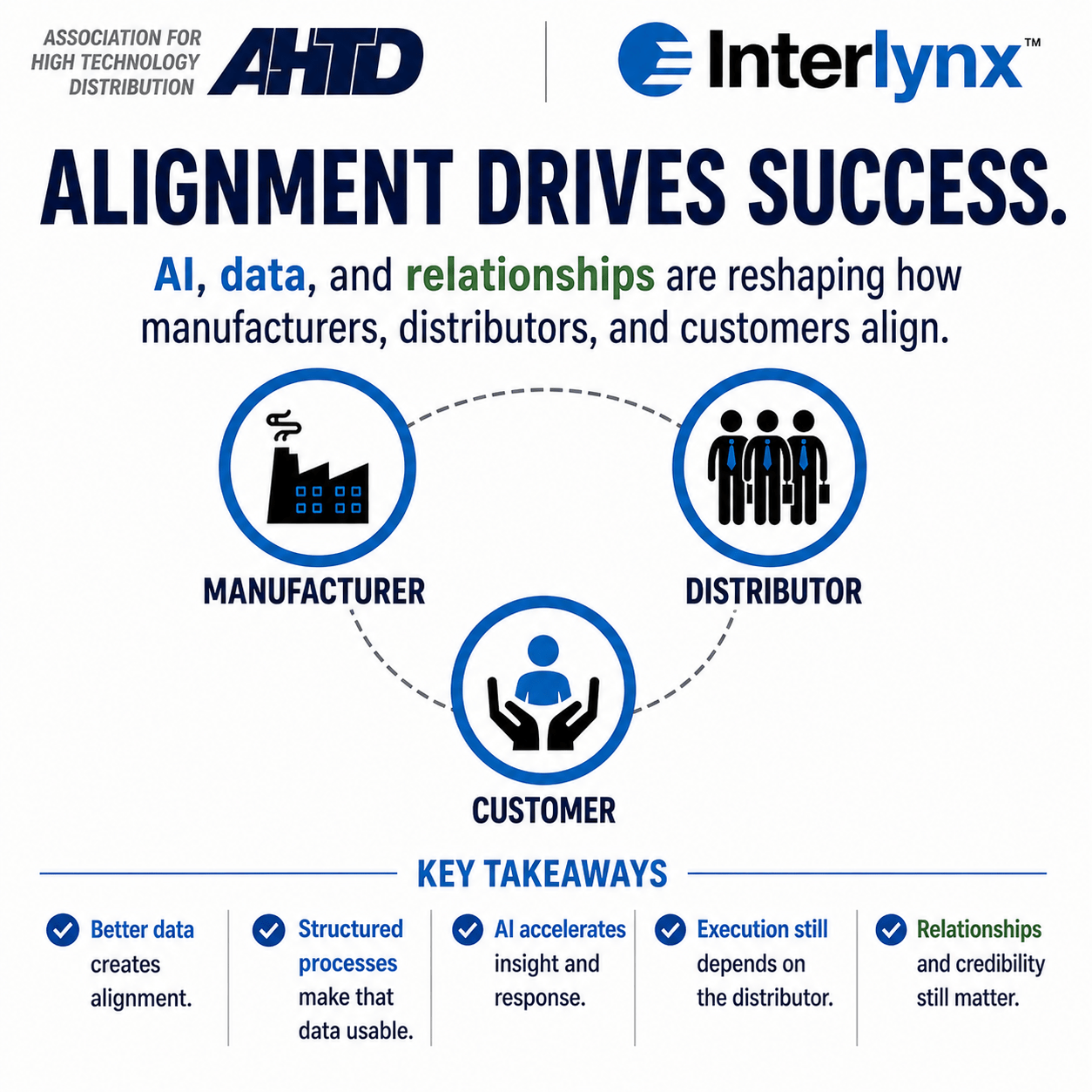
This only works when three things are in place—good data, a structured process around that data, and then AI layered on top. Without that, AI doesn’t help much.
But when there’s discipline behind it—where leads are enriched and routed with context—now that information is available upfront. They’re starting informed, and that changes the interaction.
That lines up the manufacturer, the automation distributor, and the customer—and helps all three succeed.
At the same time, the relationship and credibility of the automation distributor still matter. The customer will know if it’s scripted, especially once the conversation goes deeper.
So, this isn’t a substitute for expertise—it’s a better starting point.
Point-of-Sale Data — A Major Opportunity If You Do It Right
Point-of-sale data is one of the most important assets in the business—but only if it’s done right.
If you do it right, it gives you a real understanding of your end customers—what they’re buying, how they’re buying, and where the opportunities are.
But that only happens with discipline.
Again, it comes back to the same idea—good data, a structured process, and then AI. If the data is inconsistent or not enriched, you’ll have it—but you won’t be able to use it.
When it’s done right, you can:
- Identify opportunities within existing customers
- See patterns across similar customers
- Guide automation distributors more effectively
That’s where point-of-sale becomes a real advantage.
But like with leads, this isn’t automatic. AI can surface insights, but it still requires interpretation. You still need someone who understands the customer and the market.
It Still Comes Back to the Data
At the end of the day, this all comes back to the data and the process behind it.
- Clean, structured data you can actually use
- Defined processes around how it’s managed
- Visibility into customers and activity
- Alignment between manufacturer and automation distributor
That’s the foundation. Without it, AI doesn’t solve the problem—it just exposes it faster.
Don’t Forget the Relationships
Now that you have the data, don’t forget the relationships.
There’s still a human element—who you work with and how you show up. Manufacturers care about the automation distributors they align with, and customers care about who they buy from.
- Integrity and honesty
- How you handle information
- Your level of expertise
- Your commitment to the customer
That’s what drives trust. Data and AI make you better, but relationships are what make it work.
Overall, it was a great meeting. The AHTD leadership team and staff put together a program that brought together what appear to be the key elements required to compete in the automation industry going forward.
It reinforced three things pretty clearly—technology, data, and relationships.
How those come together, and how well companies execute on them, is really what’s going to define success from here.”
Larry, thank you for the contribution and your insights.
What Does it Mean
- The automation space is a component of the electrical and there are a number of distributors who are “broad-line” and hence members of NAED, who are members of AHTD as they recognize this as a unique segment with different manufacturers, most of whom are not NAED members as they typically have a more selective distribution authorization model and a more “technical” sale.
- The industrial automation space seems to be a growth segment given the increase in the overall industrial segment.
- Many distributors in this segment are small to mid-sized companies. Motion is a significant player with an electrical automation business approaching $1 billion.
- While many of these distributors focus on geographic areas, there are also a number that are vertical market specialists and serve accounts nationwide.
- And yes, many of these companies compete against Rockwell Automation.
- AI is a topic everywhere.
- And AHTD has a limited number of AI companies as Strategic Business Partners to support their members.
- Digital is applicable to all also. For the industrial customer, the key is technical product content on the website (and unfortunately, many of the manufacturers in this segment historically have not participated in IDEA due to their selective distribution focus.
- And sessions covered “soft” skills of leadership and relationships, which are the cornerstones of the business.
- The final session was covered the industrial segment of the economy and was presented by ITR.
- The cost to join AHTD is very reasonable and the same for all members. Further, to ensure active participation, and value to all, they require distribution members to attend at least one meeting per year.
If you attended AHTD, what were your takeaways?

Trending Now

Controlling Technology Expenses

What CEDIA Already Knows About Systems Delivery
You may also like


